Storm tracking & trajectories
Real-time storm tracking and trajectories
Storm Predict tracks storm cells continuously and works out where they are heading.
Town by town, down to the kilometre and the minute, from radar, lightning and forecast models.
Where are the storms right now?
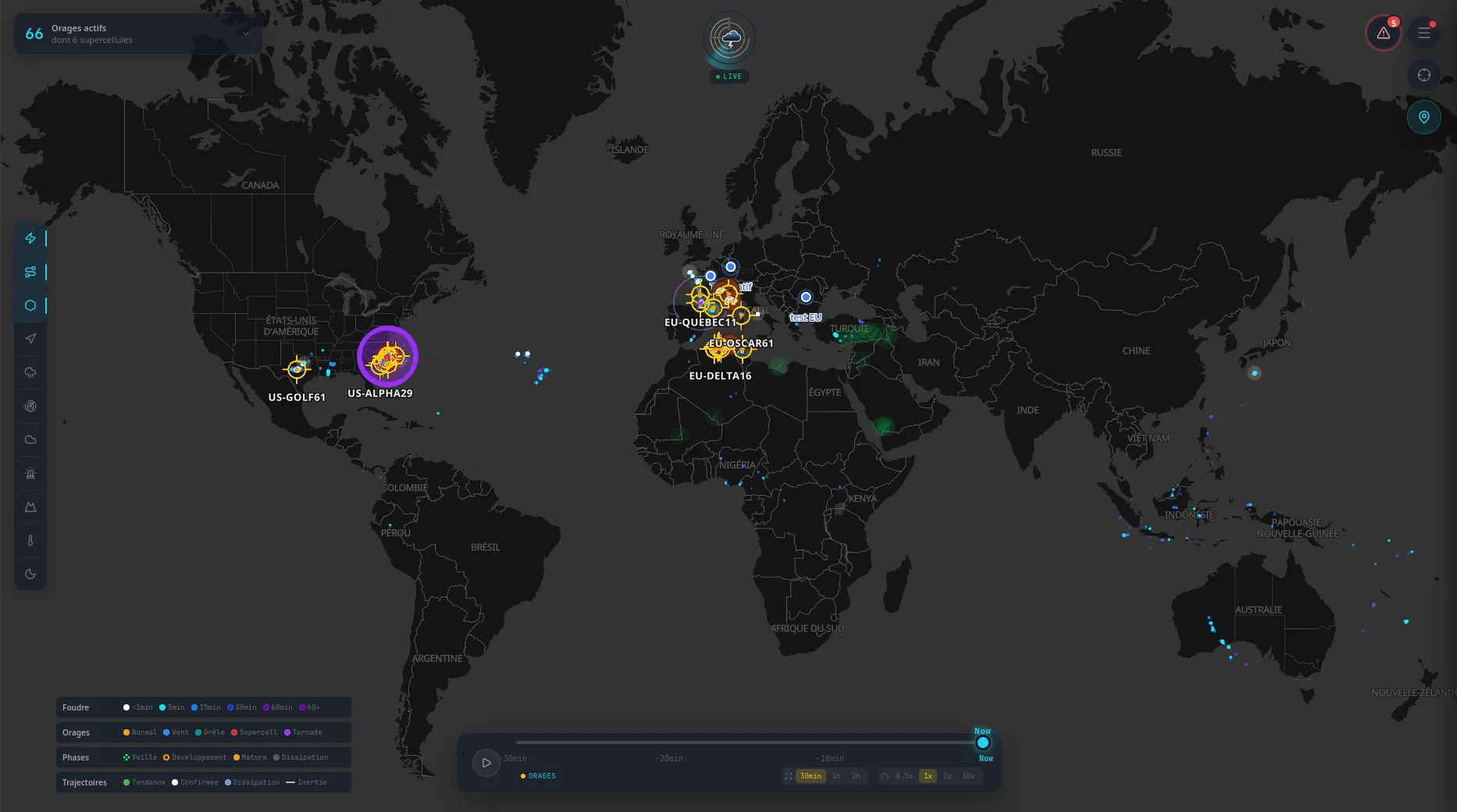
Cells tracked live across Europe, with paths and arrival times.
Open live trackingInstant answer, no account
Our risk scale
6 levels, no green
- None
- Low
- Moderate
- High
- Severe
- Exceptional
And when data is missing, we say so. An absent measurement is not an absence of risk.
Want to follow the storm? Here is the tool for it.
Precise tracks, live lightning, composite radar, steering winds, convective indices: the whole toolkit, so the storm never catches you out again.
Three steps, and one decision: yours.
You name the places you want watched. We scan the sky above them continuously, without a break. You get alerted when it concerns you, and nothing the rest of the time.
- 01
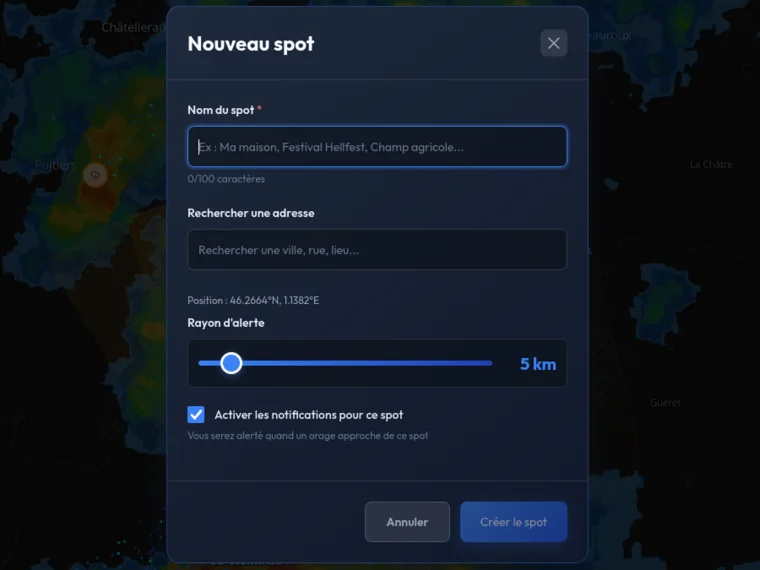
Name what matters to you
A house, a worksite, a mountain pasture, a trailhead. A single point is enough, with no need to draw an area.
- 02
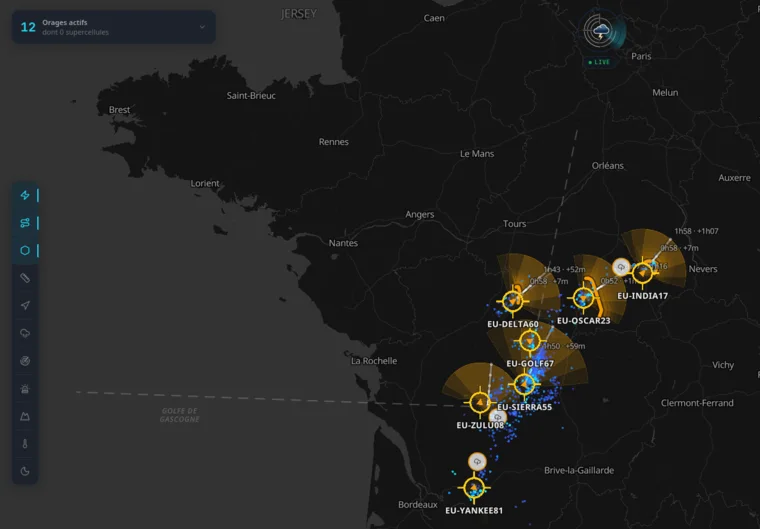
We track EVERY storm
Every precipitation core becomes an identified object, with its intensity, its speed and its track.
- 03
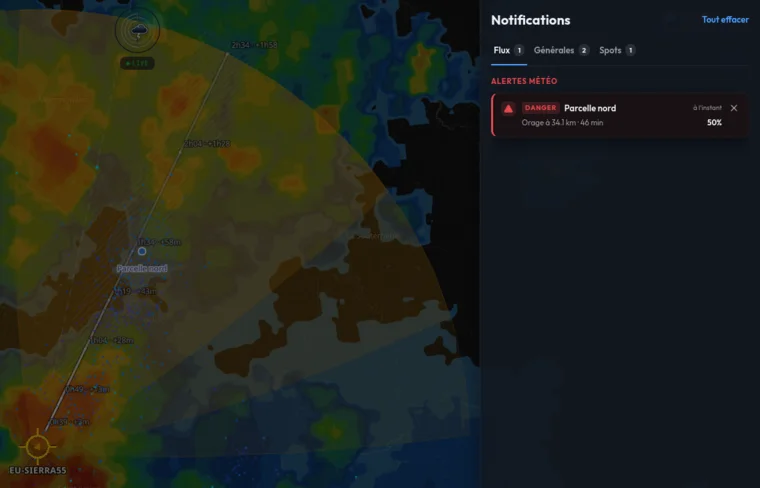
You get warned
A notification or an SMS (conditions apply) as soon as a cell heads for one of your places, with the estimated time and the expected hazards.
Our work stops here. We decide nothing on your behalf. You get what we measure, what we forecast, and the margin of uncertainty that comes with it. Pulling the tarp, delaying a start, clearing a site: the call is yours, and you make it an hour ahead instead of living through it.
Depending on what you have to protect.
Three situations, three ways in. The first one is free, and it will stay that way.
-
Following the season
The live map, the tracks and their cones, alerts on your places. For anyone watching the sky all summer.
Try 7 days -
Deciding for others
When the call commits teams, equipment or a contracted slot, a free page is no longer enough. It is not a matter of price, it is a matter of commitment.
Storm Predict Pro
Storm Predict in the press
What journalists say after seeing it work in the field.
« Ce Haut-Savoyard a créé un site web de prévision des orages »
Subscribers only
« Il est capable de réajuster la trajectoire de l’orage en fonction des paramètres relevés en direct »
Frequently Asked Questions
How is this different from a weather app?
A weather app gives you a forecast for an area and a day. We track objects: every storm cell is identified, measured and extrapolated individually. That is what makes it possible to answer “in how many minutes” rather than “today or not”.
What is free, and for how long?
The daily risk, town by town, with no account and no limit on how often you look. It will stay free. What you pay for is live tracking, alerts on your own places and replay of past episodes.
How far ahead do the tracks go?
Four hours on organised systems, around one hour on an ordinary storm. Beyond that, extrapolating an observed motion stops making sense and we hand over to numerical models, AROME first among them. Mean error is 6.8 km at thirty minutes, it is shown with the track, and we keep improving it.
What happens when data is missing?
The “no visibility” state is shown explicitly, with a dashed treatment. We never replace a missing measurement with a reassuring estimate: absent data is not an absence of risk, and the two do not look alike on screen.
What is the geographical coverage?
Cell tracking works worldwide. Resolution is around one kilometre over France, where we rely on Météo-France's AROME model, and around three kilometres elsewhere. The town-by-town risk pages, however, only cover France.
How do I get warned?
By notification, or by SMS where conditions allow. The trigger is a track crossing one of your points, never a county-wide bulletin: you are alerted when it concerns you, and not the rest of the time.